
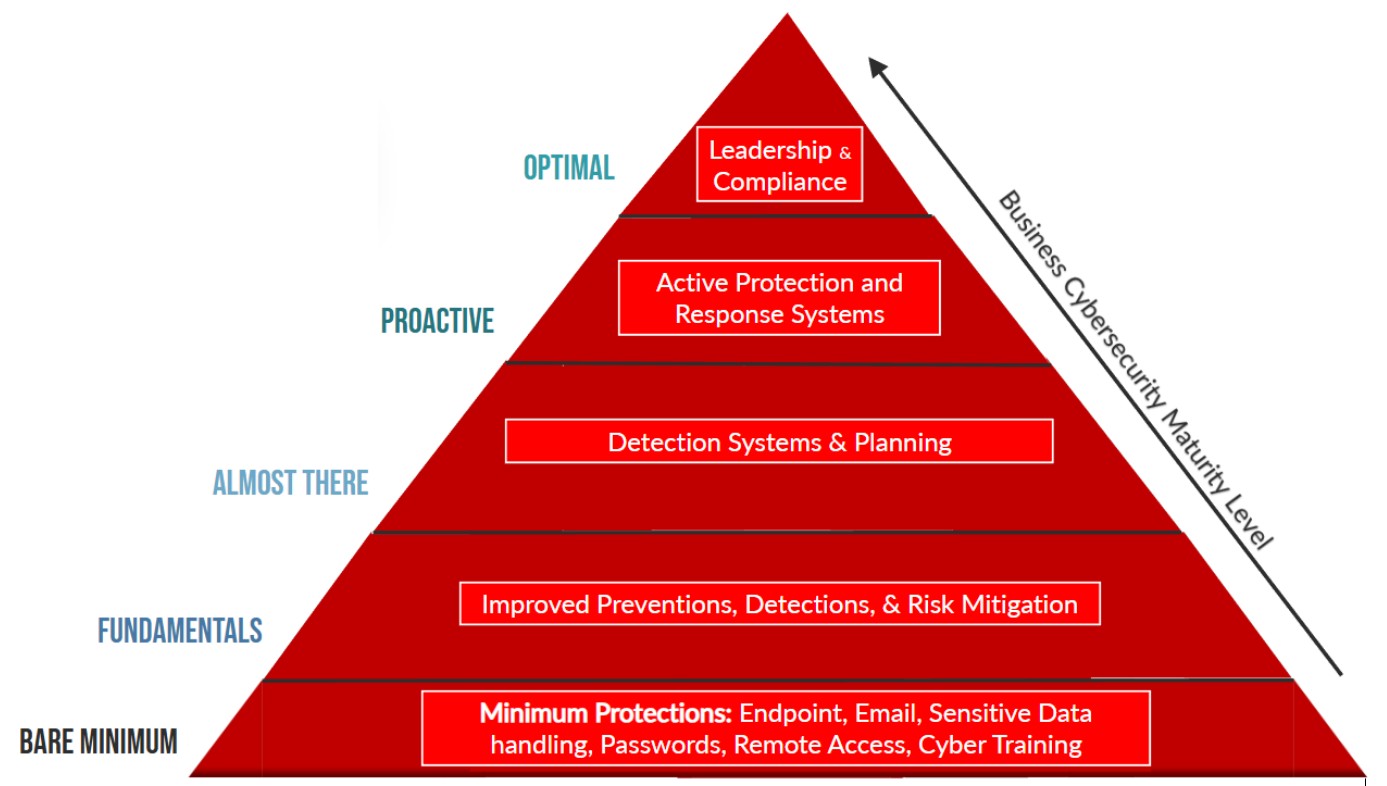
MSPs face many challenges when educating, supporting and advising clients on security. The Cybersecurity Pyramid provides a hierarchical view of the tools, people and processes that contribute to an organization’s overall cybersecurity maturity.
More than a technical model, the Cybersecurity Pyramid, developed by Business CyberSecurity Solutions (BCSS), serves as a conversation framework. It helps MSPs align security discussions with business priorities rather than fear, uncertainty and doubt. In practice, it clarifies where an organization stands today and what steps are required to mature over time.
Ultimately, how an organization progresses through the Pyramid depends on its leaders’ philosophy toward security investment.
Common Executive Philosophies on Cybersecurity
Cybersecurity adoption generally falls into three common executive personas:
- Risk-tolerant decision-makers, who are unmotivated to invest
- Risk-averse decision-makers, who need help prioritizing investments
- Revenue-minded decision-makers, who must comply to compete
Each persona approaches the subject of cybersecurity risk differently. The Cybersecurity Pyramid gives MSPs a flexible framework for engaging all three.
1. The Risk-tolerant Decision-maker
Risk-tolerant leaders often view security as a discretionary expense rather than a business enabler. Having avoided a major incident so far, they assume breaches are unlikely or manageable if they occur.
For this persona, leading with worst-case scenarios or regulatory threats is usually counterproductive. Instead, focus on foundational security practices at the base of the Pyramid and how they reduce operational friction, downtime and hidden costs. Framing cybersecurity as incremental improvement rather than radical transformation lowers resistance.
At this stage, it is critical to clearly define your MSP’s minimum acceptable security stack required to deliver effective monitoring, management and support. For many MSPs, this includes baseline endpoint and email protection.
That minimum standard becomes the client’s Pyramid baseline. Prospective clients unwilling to meet it allow you to “lose early” rather than invest time selling to an organization that will never align.
For existing clients, this transition often requires careful communication and a defined timeline. Ultimately, there are two viable outcomes:
- Formal acceptance of risk through a written waiver limiting MSP liability
- A transition to another provider whose risk tolerance aligns more closely with their own
The bottom line: clients who resist foundational security investments consume disproportionate time and increase the likelihood of serious incidents. Don’t allow a customer’s risk tolerance to become your operational or legal exposure. While it may be tempting to retain these clients for revenue, operationally, they often cost more than they contribute.
2. The Risk-averse Decision-maker
Risk-averse leaders already understand the importance of security. Their challenge is prioritization. The Cybersecurity Pyramid is particularly effective here because it introduces structure and sequencing into decision-making.

Ron Searle
Rather than treating security as a checklist of unrelated controls, the Pyramid emphasizes dependency and progression. MSPs can highlight why certain investments must precede others, helping clients avoid overspending on advanced tools before addressing foundational gaps.
This layered approach allows risk-averse leaders to make phased, informed investments aligned with budget and risk tolerance. It reduces anxiety, builds trust and positions the MSP as a strategic advisor rather than a product vendor. This approach reinforces your MSP’s long-term role as a strategic partner.
In practice, personas are not always static. Many organizations begin from a risk-avoidance mindset and later become revenue-driven after customers, insurers or regulators impose explicit requirements. The Pyramid supports this natural evolution from reactive concern to strategic enablement.
3. The Revenue-minded Decision-maker
Revenue-minded leaders view cybersecurity as a gateway to market access, customer trust and contractual eligibility. In many industries, security goes beyond a differentiator to being a prerequisite for doing business.
For this persona, the Cybersecurity Pyramid provides a clear roadmap for achieving and demonstrating compliance. By mapping regulatory requirements and industry standards to specific layers of the Pyramid, MSPs can explain not only what is required, but why.
This approach reframes security from a cost center into a revenue enabler. This directly supports sales growth and competitive positioning.
How to Identify the Persona
A simple question can quickly reveal a buyer’s philosophy:
“Are any of your customers, partners, or prospects requiring cybersecurity as a condition of doing business?”
- Yes → Revenue minded
- No, but insurance or compliance applies → Risk averse
- No requirements and minimal controls in place → Risk tolerant
Summary
Across all three personas, the Cybersecurity Pyramid’s true value lies in translating technical complexity into business-relevant language. It creates a shared mental model focused on maturity rather than fear, and progression rather than perfection.
Rather than forcing abstract “best practice” standards, MSPs can meet clients where they are. This allows MSPs to guide clients at a pace aligned with risk tolerance, operational maturity and strategic goals.
Cybersecurity is not a one-time project. As organizations evolve, so, too, must their security posture. The Pyramid provides a stable framework for revisiting these conversations over time. It supports ongoing engagement in prospect meetings, QBRs and long-term advisory relationships.
Ron Searle is CEO of Business CyberSecurity Solutions (BCSS). He has nearly 40 years of experience as a CEO, virtual CIO, and virtual CISO. BCSS works with MSPs that want to move beyond tool-centric cybersecurity conversations and toward structured, defensible security maturity programs, including the delivery of vCISO services. Learn more about the Cybersecurity Pyramid framework.
Images: BCSS