

We’ve all heard countless promises about how AI can help MSPs work more efficiently, reduce costs and serve more customers. Yet evaluating all the new tools and capabilities entering the market can be daunting for service providers.
ConnectWise wants to simplify that process by embedding AI into the technology MSPs already use. The goal is to remove repetitive work from technicians’ plates, streamline daily operations and help service providers expand their customer base without growing headcount at the same rate.
“A lot of what AI does is take the routine, mundane, everyday tasks that you have as an MSP, and the technology does them for you,” ConnectWise CEO Manny Rivelo told ChannelPro in an interview. “If that intelligence then can solve those issues, you have the capacity to do other things. That’s the core vs. context conversation that I talk about. What is core to an MSP is what differentiates them. If I’m an end customer, I want to buy the service from you. It’s not because you sell tickets.”
That philosophy is driving ConnectWise’s approach to AI. Whether simplifying technology stacks or rethinking how to deliver and price services, providers must focus on business outcomes. During IT Nation Connect Global 2026, Rivelo and Chief Product and Technology Officer David Raissipour outlined four ways MSPs can put that into practice.
1. Standardize your technology stack

Manny Rivelo
Before MSPs can take full advantage of AI, they need a technology foundation that supports automation. Start with an assessment of the tools you use to run your business, Rivelo recommended. Streamlining the stack can make it easier to connect information, automate workflows and apply AI across operations.
“I’d standardize as best as possible to get common data, a reasoning engine and a system of record,” Rivelo said. “You could do all that by thinking about your tech stack.”
That approach is central to the ConnectWise AI strategy. Rather than offering automation as a separate tool, the company is integrating agentic capabilities directly into its platform. ConnectWise says embedding those capabilities in its platform can reduce the integration work required to adopt AI.
ConnectWise also wants to give partners the flexibility to create agents that address their specific business needs, Raissipour told ChannelPro. The company’s emerging build-your-own-agent capabilities use the ConnectWise agentic framework, which incorporates integrations, monitoring and governance controls.
2. Start with one repetitive task
MSPs don’t need to automate their entire business to benefit from AI. Instead, identify one routine activity that consumes significant technician time, Rivelo advised.
Automating credential resets, for example, tasks could reduce ticket volume and give technicians more time to address complex customer needs. These early projects offer an opportunity to build confidence in AI across the organization, Rivelo added. “Then, use that as a vehicle to educate your MSP and change the culture.”
ConnectWise is working to make that first step easier through its Agent Lab. MSPs using the company’s platform can select prebuilt agents that are trained for their respective environments.
They also can use a feature called “shadow mode” to evaluate an agent’s decisions before allowing it to take action. “The implementation timeline is really simple,” Rivelo noted. “If you could put the agent in shadow mode, it will tell you what it’s going to do but won’t actually do it.”
Technicians can review the agent’s proposed actions before deciding which tasks to authorize. Once they are comfortable with its performance, they can disable shadow mode and allow it to operate more independently. For MSPs hesitant to embrace automation, that gradual approach offers a way to gain experience without immediately handing over control.
3. Automate responsibly, not just quickly

David Raissipour
With AI tools becoming easier to build, MSPs may be tempted to develop their own agents for every problem. However, Raissipour cautioned that creating an automation is only part of the challenge. Security, governance, ongoing maintenance and scalability also matter.
Raissipour pointed to AI developers who quickly create custom agents but lack the infrastructure to support them over time. That can introduce risks for MSPs and their customers. “I sincerely believe that people are underestimating the risk associated with AI that is not governed, monitored or carefully planned,” Raissipour said.
Instead of choosing technology based on the latest AI capabilities, MSPs should identify the business problem first. “Design for the outcome, not for the tool that you have in front of you,” he advised.
That means understanding what needs to improve, determining how success will be measured and selecting technology that can deliver the desired result. It also means recognizing that building an AI solution internally isn’t always the best use of an MSP’s resources.
ConnectWise’s approach is to provide a framework that partners can use to develop their own automations while relying on the platform’s underlying capabilities.
4. Turn greater efficiency into better service
Some service providers worry that AI will force them to reduce prices or eliminate jobs. Instead, they should think about using automation to expand what they can deliver.
Rather than replacing technicians, MSPs can redirect their expertise toward work that requires judgment, creativity and a deeper understanding of customer needs, Raissipour explained.
“The industry as a whole is not out to see how many people we can put on the unemployment line. The goal is to figure out how many people can we free up to go solve the next problem that I can’t automate and deliver more value.”
MSPs also can use AI to deliver better services to their clients. For example, they can:
- Improve response times
- Strengthen service-level agreements
- Potentially prevent problems before customers experience them
Eventually, that shift could change how MSPs charge for their services. The industry’s traditional endpoint-based pricing model may give way to more outcome-based approaches as automation improves, Rivelo said. “What if I said, ‘You, Mr. Customer, have 50 or 100 tickets a month. If I can get that down to five tickets a month, would you pay me more?'”

Ann Westerheim
Preventing recurring problems and reducing customer downtime could provide stronger measures of value than ticket counts alone. It also creates an opportunity for MSPs to differentiate themselves based on service quality rather than price alone. That resonated with Ann Westerheim, founder and president of Greater Boston-area MSP Ekaru.
“ConnectWise is clearly going all in on AI with capabilities spanning PSA assistants, intelligent ticket intake and agents for tasks like dispatch, backed by aggressive trials and pricing,” Westerheim told ChannelPro. “Throughout the conference, there was a consistent message that MSPs investing in these tools are seeing stronger operational performance and profitability. The big question now is how MSPs turn that promise into measurable results. The opportunity is clear, but successful execution will be what separates the leaders.”
Turning AI’s promise into measurable results
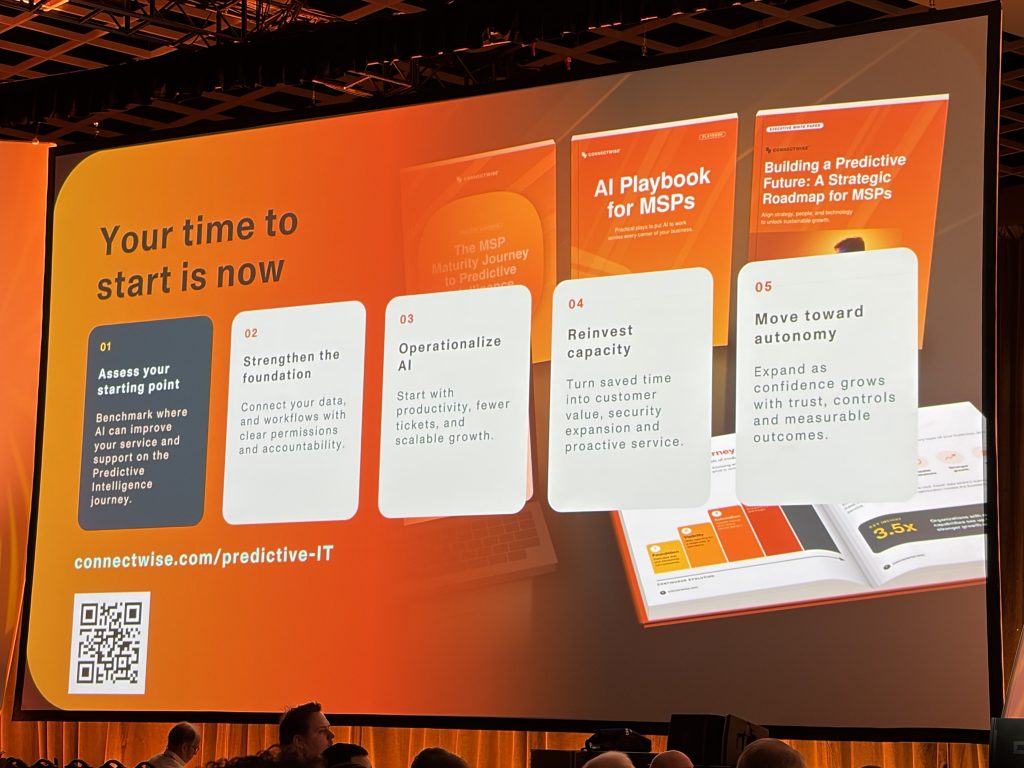
Of course, MSPs are not going to transform their businesses overnight. However, Rivelo and Raissipour agreed that the fast pace of AI development should encourage MSPs to experiment now.
It doesn’t have to be complicated. Identify a recurring problem, determine whether automation can solve it and measure the results. From there, MSPs can expand their use of AI while building the experience and confidence needed to take on more complex tasks.
The ultimate objective isn’t simply to process more tickets with fewer people. It’s to spend less time on routine work and more time delivering the expertise and service customers are willing to pay for.
More ChannelPro coverage from IT Nation Connect Global
 5 ways MSPs can turn ConnectWise’s AI vision into business value
Anjali Fluker is managing editor of The ChannelPro Network, where she covers news, trends and best practices for the MSP community. She specializes in telling the stories that matter to IT providers serving the SMB market. When she’s not reporting, writing or editing, she’s connecting with channel pros at industry events across the country.
Images: Anjali Fluker/ChannelPro