

At first glance, it may appear that building profitable services a tough battle for an MSP. A provider can have a strong technical team and still leave growth opportunities untouched. Its engineers may be busy delivering complex projects for its largest clients while opportunities among smaller customers go untapped.
Hiring more people is one response. But before adding payroll, providers should examine three key things:
- Which customers they serve profitably
- Where they could deliver more value
- Which capabilities they can access through partners
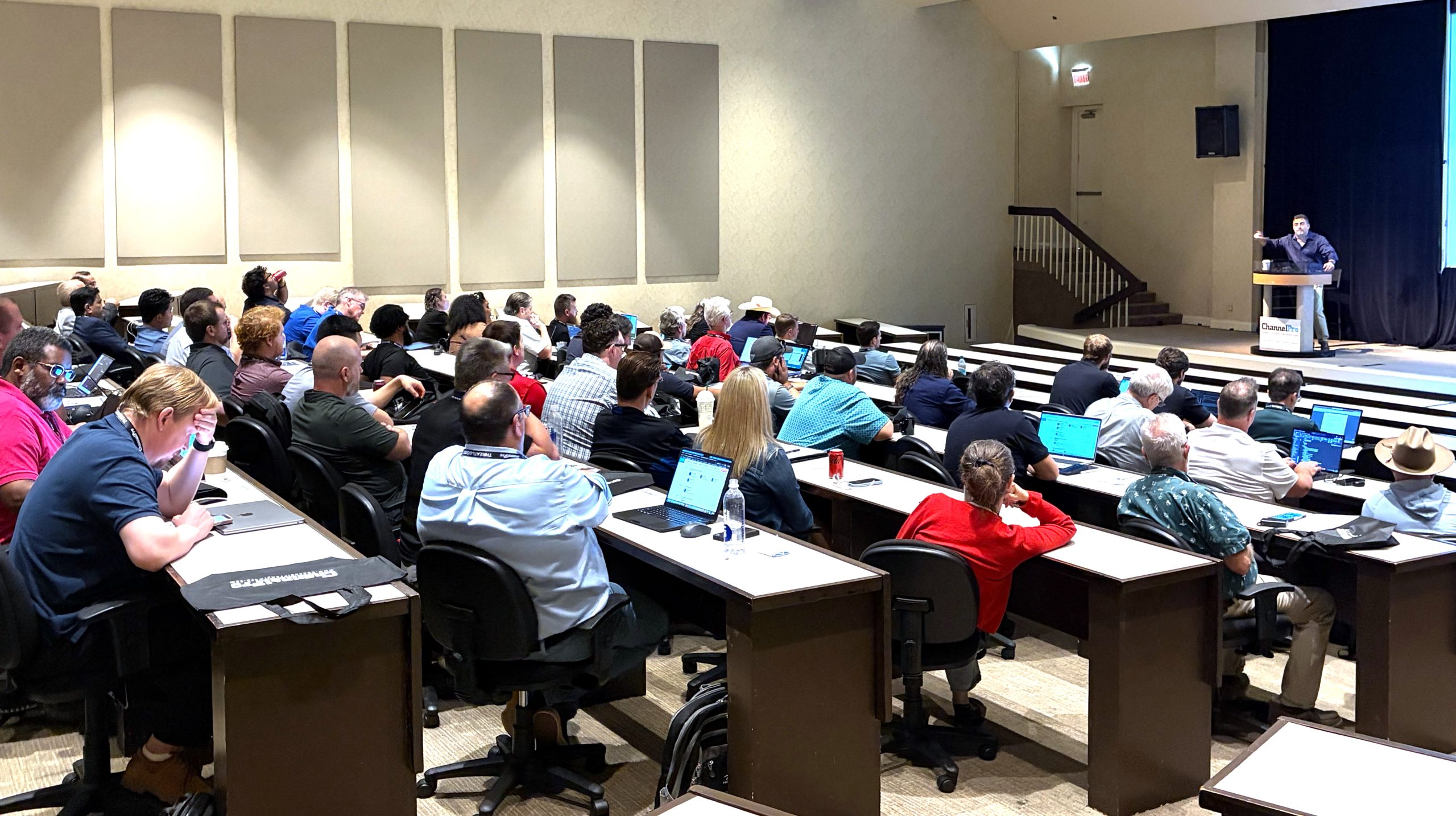
That was a central message from Patrick O’Dell, executive director of services sales for Ingram Micro, during his presentation at MSP Summit in Orlando, Florida. In an interview with ChannelPro later that day, he expanded on how providers can build a more scalable services business.
His presentation, From MSP to SSP: Building a More Profitable Services Business, framed the transition as a shift to strategic service provider. The practical distinction was a change in focus from daily service delivery to strategic relationships, customer outcomes and recurring revenue.

O’Dell presents at MSP Summit 2026.
O’Dell illustrated the potential impact on business valuation. His presentation put EBITDA multiples at four to six times for MSPs with break-fix and project-heavy revenue. For SSPs generating more than 80% of revenue from recurring, consumption-based services, the range was 10 to 12 times EBITDA.
“Growth oftentimes is capped by time and tickets. It’s capped by headcount. It’s capped by uptime in the never-ending SLA race,” O’Dell said during his presentation.
Strategies for a more profitable services business
For MSPs looking to move beyond existing limits, O’Dell’s advice points to five places to start:
1. Evaluate the customers you already have
Growth planning should begin with an assessment of the existing customer base, O’Dell said. That means stepping away from daily demands long enough to understand each relationship’s profitability and value.
Some accounts may generate revenue without contributing enough to the business. Being busy serving them can make that harder to recognize.
“Sometimes it’s okay to say no to the wrong kind of business,” O’Dell told ChannelPro. “Being stuck in the business sometimes removes your perspective in that way. That’s an important starting point.”
The takeaway: Customer count alone does not tell an MSP whether it is building a healthy business. Understanding the economics of individual relationships helps establish where growth efforts should go.
2. Look beyond your biggest accounts
O’Dell described a recurring conversation with established providers. They have engineers, a services team and proven capabilities. But when he asks how many customers receive their full range of professional services, the answer often favors larger accounts.
That leaves an opportunity among smaller clients that may need more help than the MSP currently delivers.
Providers should assess how broadly they offer services across their customer base.
- Which clients receive comprehensive support?
- Which could benefit from additional security, cloud or productivity services?
Expanding those relationships can create growth without requiring the MSP to acquire a new customer for every new opportunity, O’Dell told ChannelPro. “Avoid that customer acquisition cost; bolt on and grow your existing base. That’s the secret sauce.”

Patrick O’Dell
3. Add capacity through delivery partners
An MSP’s service offerings do not have to stop at the limits of its internal team.
O’Dell pointed to co-delivery and white-label arrangements as ways to access technical capabilities while retaining the customer relationship. Ingram Micro, for example, can work behind the scenes or alongside a provider, he said. The approach allows MSPs to keep delivering work within their core competencies while using outside resources to serve more customers.
He also highlighted funding for cloud assessments and migrations. Accessing and managing that funding can take significant effort, he said. A partner that helps navigate the process can make projects easier to pursue.
For smaller providers, the broader lesson is to assess available expertise and resources before assuming a new offering requires another full-time employee.
4. Lead with a use case, then support adoption
AI illustrates why adding a product does not automatically create a scalable service.
Providers can struggle with the initial client conversation because they lack a concrete example of what the technology could accomplish, O’Dell explained. Rather than waiting for customers to identify a problem, MSPs can bring relevant examples from similar businesses.
He described Ingram Micro’s Enable AI program as a source of guidance, case studies and access to AI experts.
Training matters, too. O’Dell said Microsoft 365 Copilot trials have not always converted to paid subscriptions as hoped. His advice was to begin enablement before activating trial licenses, giving customers more time to understand and use the tools.
5. Build governance into the service
Deploying AI is also the beginning of an ongoing responsibility. Clients need confidence that their data is ready, their environment is secure and employees use the technology appropriately, O’Dell said. Governance gives MSPs an opportunity to provide continuing value beyond the initial deployment.
That requires buy-in throughout both organizations, O’Dell told ChannelPro. “It’s really about a commitment — top-down, decision-makers, middle tier, all the way to the front line. There needs to be a commitment at the customer level and at the reseller level that this is the transition that we’re going to make.”
For MSPs, scaling starts with those business decisions: choosing healthy relationships, identifying unmet needs and building the capacity to address them consistently.
Read more ChannelPro coverage of MSP Summit 2026
➡️ MSP Summit takeaways: Growth starts with proving your value to clients
Anjali Fluker is managing editor of The ChannelPro Network, where she covers news, trends and best practices for the MSP community. She specializes in telling the stories that matter to IT providers serving the SMB market. When she’s not reporting on the latest in managed services, she’s connecting with channel pros at industry events across the country.
Images: Suparto — stock.adobe.com, Anjali Fluker/ChannelPro